Tracing synchronization hurdles between legacy accounting tools and modern recurring payment platforms across established retail chains
Written by Elena Washington · Oct 2, 2026
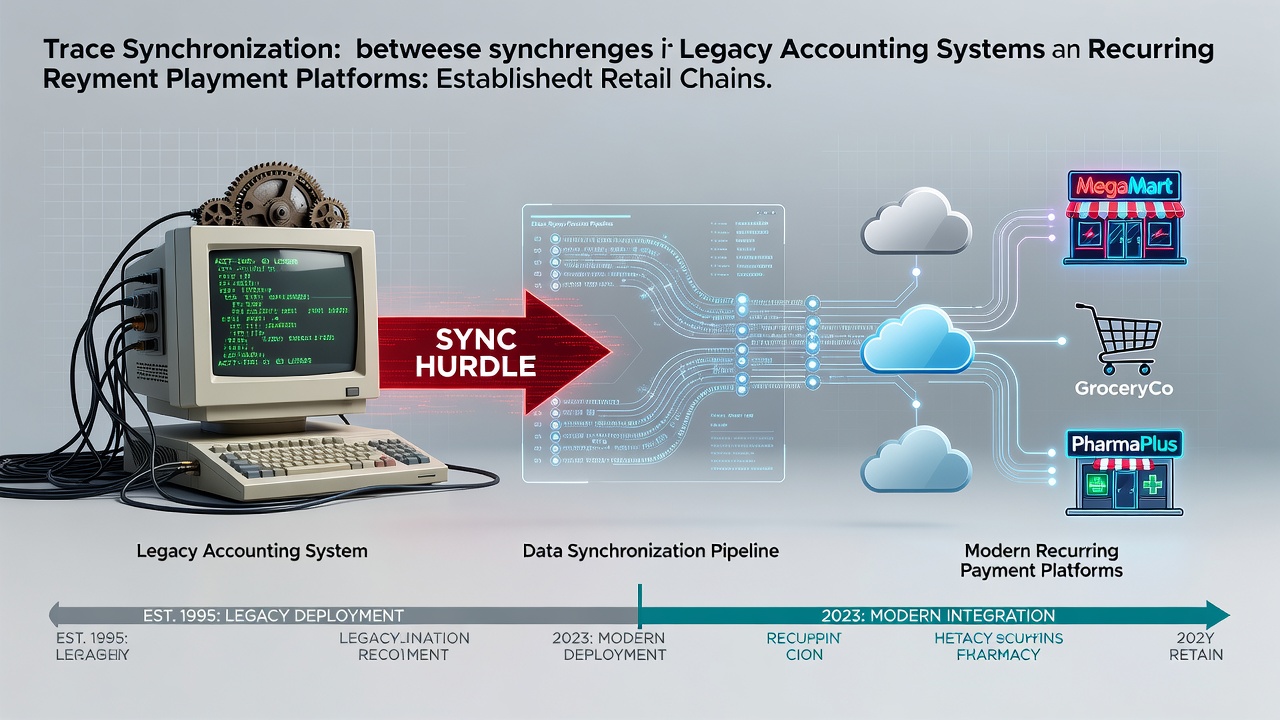
Tracing synchronization hurdles between legacy accounting tools and modern recurring payment platforms across established retail chains
Established retail chains continue to face synchronization hurdles when connecting legacy accounting tools with modern recurring payment platforms, and these issues stem from mismatched data structures alongside processing timelines that differ significantly between older batch-oriented systems and newer API-driven services. Observers note that many chains rely on accounting software developed decades ago which processes transactions in daily or weekly batches, whereas contemporary platforms such as subscription billing engines handle charges in real time and require immediate confirmation of payment status.
Researchers have documented how data format incompatibilities create the first layer of friction because legacy tools often store records in fixed-width files or proprietary databases, while modern platforms transmit information through JSON or XML schemas that demand conversion layers to avoid corruption during transfer. One study from the National Institute of Standards and Technology highlighted that retail operations spanning multiple locations encounter repeated mapping errors when customer identifiers and subscription metadata fail to align across these disparate formats.
Timing discrepancies in transaction flows
Timing discrepancies emerge when legacy systems cannot accommodate the instantaneous validation loops demanded by recurring payment gateways, and this mismatch leads to delayed reconciliation reports that leave merchants uncertain about which subscriptions have succeeded or failed on any given cycle. As of October 2026, industry data from the Australian Competition and Consumer Commission indicates that chains operating in multiple time zones report elevated error rates during peak billing periods because batch jobs scheduled overnight clash with live authorization attempts originating from international platforms.
Retail operators often discover that currency conversion routines embedded in older accounting modules do not refresh at the same intervals used by modern gateways, which results in rounding differences that accumulate over thousands of recurring charges and require manual intervention to balance ledgers. Those who have examined these patterns observe that synchronization scripts must run continuously rather than on fixed schedules to prevent drift between the two environments.
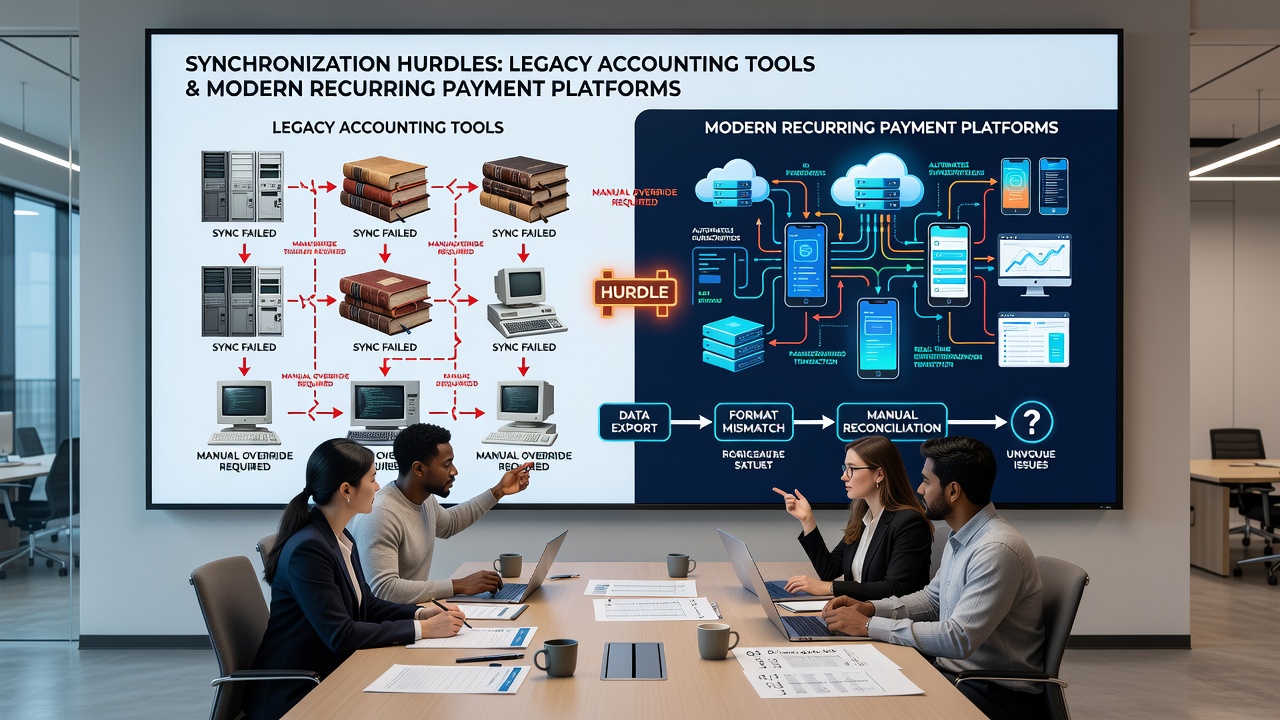
Compliance and security considerations
Compliance requirements add another dimension because legacy accounting tools frequently lack the encryption standards and audit logging capabilities expected by current payment platforms under frameworks such as the Payment Card Industry Data Security Standard, and chains must therefore insert intermediary middleware that introduces additional points of failure. Data shows that European retail groups have addressed some of these gaps through phased migrations documented in reports from the European Central Bank, yet full synchronization remains elusive when older modules cannot expose granular access controls required for recurring charge handling.
Security protocols also diverge because modern platforms enforce tokenization and dynamic authentication for each recurring cycle, whereas legacy systems store card details in static fields that demand extensive rewriting to meet contemporary expectations. Observers note that chains attempting direct connections without proper middleware experience elevated rates of declined transactions stemming from mismatched authentication sequences.
Examples from retail operations
Take one major grocery chain that integrated its decades-old general ledger with a cloud-based subscription service for loyalty rewards and discovered that daily sales files overwrote partial subscription updates before they could be recorded, and this forced developers to build custom staging tables that poll both systems every fifteen minutes. Another department store group encountered similar hurdles when its inventory accounting module rejected recurring payment confirmations formatted with metadata fields absent from the original database schema, prompting the creation of translation routines that run alongside nightly batch processes.
Figures reveal that mid-sized retail networks with fifty or more locations experience the steepest synchronization costs because each additional store multiplies the volume of recurring entries that must be reconciled across time zones and regulatory jurisdictions. Experts have observed that middleware solutions capable of bidirectional synchronization reduce these volumes by converting real-time events into batch-compatible records without losing critical status flags.
Pathways toward improved alignment
Retail chains have begun deploying API abstraction layers that sit between legacy accounting tools and modern recurring platforms, and these layers translate live payment events into formats the older systems can ingest while preserving timestamps and identifiers needed for accurate financial reporting. Research indicates that organizations adopting such layers report fewer reconciliation discrepancies during high-volume billing windows, although initial configuration still requires extensive mapping of every data field used by both environments.
Additional progress appears when chains schedule overlapping validation windows so that legacy batch jobs and modern authorization callbacks operate within shared time buffers, and this approach minimizes the window during which payment outcomes remain invisible to accounting records. Those who've studied these implementations note that continuous monitoring dashboards help surface synchronization drift before it affects monthly close processes.
Conclusion
Tracing synchronization hurdles between legacy accounting tools and modern recurring payment platforms shows that established retail chains must navigate data format differences, timing conflicts, and compliance gaps that arise when older batch systems meet real-time services. Evidence from multiple regions demonstrates that middleware, scheduled validation overlaps, and continuous monitoring provide measurable improvements, yet complete alignment continues to require ongoing adaptation as both legacy and modern environments evolve.